
Maximize Revenue: Price Holiday Weeks Effectively
Pricing, Holiday Weeks
How to Price Holiday Weeks for Maximum Revenue
The seven peak weeks of your calendar should pay for half your year. Here’s how to price holiday windows like a host who actually runs the numbers, using the same discipline you’d apply to a production system in code.
Every property has roughly seven weeks of premium-demand booking windows per year: Christmas, New Year’s, spring break, Memorial Day, Fourth of July, Labor Day, Thanksgiving, plus whatever big local event spikes your market. Those weeks should generate close to half of your annual revenue. In 2026, when U.S. short-term rentals average roughly $259–$369 per night and ADRs are still trending up even as occupancy softens (StayFi, AirROI), you cannot afford to wing this.
My first New Year’s Eve as a host, I priced like a newbie engineer guessing at server capacity. I set $325 a night—almost double my normal rate—and felt clever when the week booked out in three days. Then I watched a nearly identical cabin two doors down book the same week at $895 a night. No special amenities, no viral listing, just a host who had actually benchmarked the market. I had effectively donated about $4,000 to a guest who would have happily paid triple. That winter cured me of “comfort pricing” for good.
1. Identify Your Seven Actual Peak Weeks (With Data, Not Vibes)
Don’t assume which weeks are premium—profile them like you would a slow API endpoint. In a beach market, Fourth of July may crush Christmas. In a ski or mountain market, Christmas–New Year’s and spring break often behave like surge traffic, especially when global travel costs are up 30–60% for that same window (TripCostGuide).
A simple workflow in Python can help you scrape or log OTA data for your comps and surface the real peak weeks:
import pandas as pd

# sample structure: date, listing_id, price, is_available
df = pd.read_csv("market_calendar.csv", parse_dates=["date"])

# define holiday windows you care about
HOLIDAYS = {
    "christmas_week": ("2026-12-20", "2026-12-27"),
    "new_years_week": ("2026-12-27", "2027-01-03"),
    "spring_break":   ("2026-03-14", "2026-04-06"),
    "memorial_day":   ("2026-05-22", "2026-05-26"),
    "july_4th":       ("2026-07-02", "2026-07-07"),
    "labor_day":      ("2026-09-04", "2026-09-08"),
    "thanksgiving":   ("2026-11-24", "2026-11-30"),
}

summary_rows = []

for name, (start, end) in HOLIDAYS.items():
    mask = (df["date"] >= start) & (df["date"] <= end)
    window = df[mask]
    avg_price = window["price"].mean()
    availability_rate = window["is_available"].mean()
    summary_rows.append(
        {
            "window": name,
            "avg_price": round(avg_price, 2),
            "availability_rate": round(availability_rate, 3),
        }
    )

summary = pd.DataFrame(summary_rows).sort_values(
    by=["avg_price", "availability_rate"],
    ascending=[False, True],
)

print(summary)
The top 7 rows by high price and low availability are your true peak weeks. Write them down. Treat them as their own product line, not just “slightly higher than normal.”
2. Charge What the Market Actually Pays — Not What Feels “Reasonable”
Comfort pricing is the silent killer of holiday revenue. If your comparable set is booking at $700/night and you’re at $400 because that feels “fair,” you’re not being generous—you’re silently burning runway. In 2026, ADRs on Airbnb are still roughly 25% above pre‑pandemic levels with 1–2% annual growth (AirROI). Guests are already paying these rates across flights, hotels, and cars; your listing is just one line in their total trip cost.
Think like you’re tuning a load balancer: the market sets the demand curve. Your job is to read it correctly. When your comp data says Christmas supports $800/night, that’s the number. Ship that config. Don’t arbitrarily shave 20% off because it makes you less nervous.
💡 Pro Tip: If a peak week books in <48 hours at full price, treat that as a failed experiment. You underpriced. Raise next year’s rate by 20–30% and re‑evaluate.
3. Set a 4–7 Night Minimum Stay on Every Peak Week
This is the single highest‑leverage configuration change you can make. A 4‑night minimum on Christmas filters out one‑night party traffic, attracts higher‑spend family groups, and slashes cleaning cycles. A 7‑night minimum on prime summer weeks converts choppy, low‑margin stays into long, profitable runs—especially valuable now that one‑night searches have exploded from ~31% to 56% of volume (StaySTRA).
If you manage availability via an API or iCal import, treat minimum stays as code, not manual toggles. For example, a simple rule engine in Python:
from datetime import date

def min_nights_for(date_obj: date) -> int:
    # Christmas week: 4-night min
    if date(2026, 12, 20) <= date_obj <= date(2026, 12, 27):
        return 4
    # Prime summer: 7-night min
    if date(2026, 7, 1) <= date_obj <= date(2026, 8, 15):
        return 7
    # Default: 2-night min
    return 2

# Example usage inside your pricing sync job
for day in listing_calendar:
    day["min_nights"] = min_nights_for(day["date"])
Many hosts are happy to raise rates but scared to raise minimums. That’s backwards. The best‑performing operators pair high ADR with long stays and let weaker weeks do the occupancy work.
4. Open the Booking Window Early — But Not Too Early
Booking windows are compressing overall—the average is down to about 60 days, and nearly 38% of searches happen within 28 days of arrival (StaySTRA). But peak weeks are the exception: big family trips, milestone birthdays, and once‑a‑year ski weeks still get planned 6–12 months out, especially when flights and hotels are 30–60% more expensive over holidays (Calculatorian).
For Christmas, New Year’s, and your prime summer weeks, open 10–12 months out with strong anchor pricing.
For second‑tier peaks (Memorial Day, Labor Day, Thanksgiving), 6–9 months is usually ideal. Earlier than that, you risk locking in too low a rate before you see what the market does.
📌 Key Takeaway: Think like operators holding rates firm while waiting for demand to materialize closer to stay dates—exactly what many U.S. vacation rental managers are doing in 2026 (LuxuryTravelAdvisor).
5. Use Dynamic Pricing Tools — But Override Them on Peak Weeks
Tools like PriceLabs, Wheelhouse, and Beyond Pricing are fantastic for the 45 “normal” weeks of the year. Hosts using dynamic pricing often see 10–40% higher annual revenue than those on static rates (StaySTRA). But algorithms are designed to smooth extremes; they tend to under‑shoot the top of the curve on absolute peak weeks.
Treat your pricing tool like an autoscaler: great for baseline, but you still hand‑tune the critical paths. A simple pattern:
def apply_peak_overrides(base_price: float, date_obj: date) -> float:
    # Example: +60% for New Year's, +40% for Christmas, etc.
    if date(2026, 12, 27) <= date_obj <= date(2027, 1, 3):
        return base_price * 1.6
    if date(2026, 12, 20) <= date_obj <= date(2026, 12, 27):
        return base_price * 1.4
    return base_price

for day in pricing_feed:
    day["price"] = apply_peak_overrides(day["dynamic_price"], day["date"])
Set your peak‑week prices manually based on comps, then let the tool handle intra‑week fluctuations and non‑holiday periods. This hybrid approach consistently outperforms pure automation.
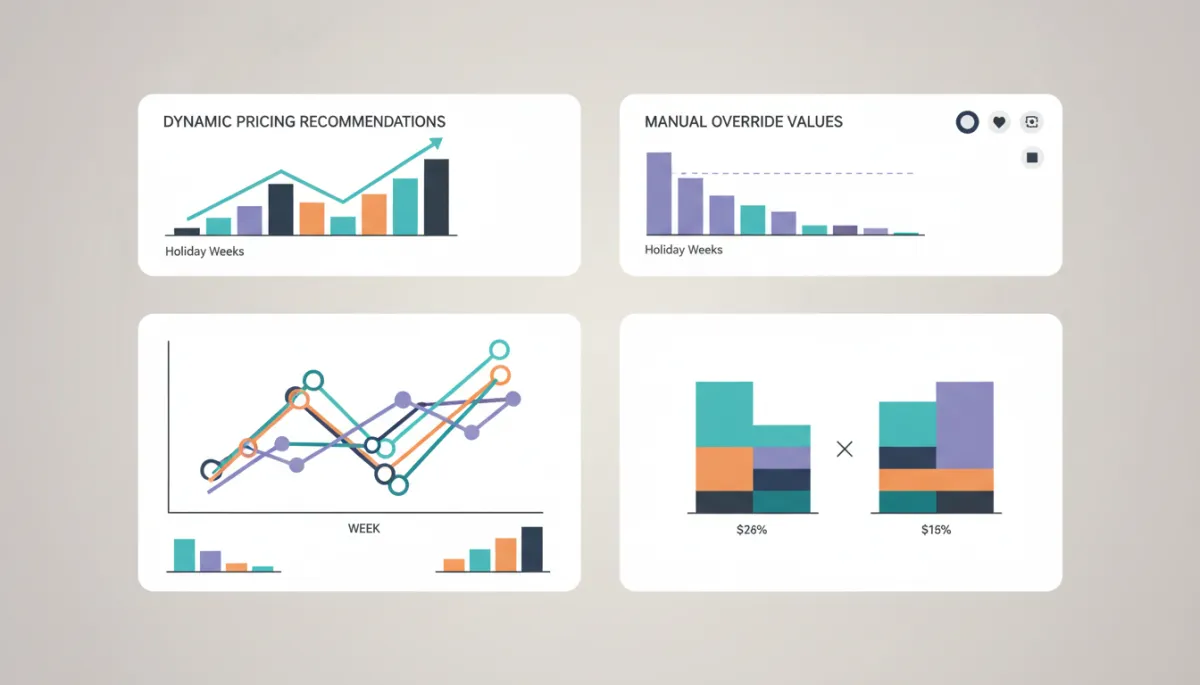
Manual overrides on seven peak weeks can add five figures of annual profit.
6. Charge a Premium for the Days That Bookend the Holiday
In practice, the night before and after a holiday often outperform the holiday itself. The Wednesday before Thanksgiving can be hotter than Thanksgiving Day. Memorial Day Sunday often beats Monday. Travelers are already paying 25–60% higher airfares on those shoulder days (TripCostGuide); your calendar should reflect that demand pattern.
Concretely, this might look like:
Thanksgiving Wed: 1.3× normal weekend rate
Thanksgiving Thu–Sat: 1.2×
Thanksgiving Sun: 1.15×
Implement this as a small multiplier map in your pricing job rather than manually nudging each night in the UI. The goal is to treat holiday adjacency as its own tier, not just “another weeknight.”
7. Audit Your Peak Weeks Every January Like a Postmortem
The first week of January, run a postmortem on last year’s peak weeks the same way you’d review a major incident in production. Pull calendar data, booking lead times, and comp pricing. Ask three questions:
Which weeks booked instantly? Those were almost certainly underpriced.
Which weeks struggled to sell out? That might indicate overpricing, but more often it’s a minimum‑stay or booking‑window issue.
What did the top‑performing comps charge, and how early did they book?
# Example: flag underpriced peak weeks
bookings = pd.read_csv("my_bookings_2025.csv", parse_dates=["check_in"])

def is_peak(check_in):
    return check_in.dt.month.isin([12, 3, 7, 11])  # rough example

peak = bookings[is_peak(bookings["check_in"])]

summary = (
    peak.groupby("holiday_window")
        .agg(
            avg_price=("nightly_rate", "mean"),
            median_lead_days=("lead_time_days", "median"),
        )
        .reset_index()
)

print(summary.sort_values("median_lead_days"))
Use those insights to set this year’s pricing. If Christmas booked 11 months out at your asking rate, you probably have room to push 20–40% higher next cycle, especially in mountain and cabin markets that are currently outperforming coastal areas (StaySTRA).
Treat Seven Weeks Like Production, Not a Side Quest
Holiday pricing is where good hosts and great hosts diverge. The great ones are not “lucky.” They identify their seven true peak weeks, let the market—not their feelings—set the rate, enforce 4–7 night minimums, open their calendars on a deliberate schedule, use dynamic tools intelligently, charge extra for shoulder days, and run a proper audit every January.
As a developer, you already think in systems, feedback loops, and data. Apply that mindset to your holiday pricing, and those seven weeks can easily fund half your year—without adding a single new property to your portfolio.