Optimize Airbnb Cleaning Fees for More Bookings
Pricing, Cleaning Fees, Airbnb Strategy
The Cleaning Fee Question: Why Yours Might Be Costing You Bookings
A high cleaning fee on a short stay doesn’t just look bad — it quietly kills conversion. As a host, you need to think about cleaning fees less like an invoice line and more like an API that guests call with one question: “Does this price feel fair?”
There’s a moment when a guest sees your cleaning fee and quietly decides not to book. No error message, no exception thrown — just a silent failure. They close the tab and keep scrolling. In 2026, with Airbnb showing total prices up front and guests hyper-aware of fees, cleaning has become one of the most sensitive lines in your entire pricing stack.
A Personal Debugging Session: When My Cleaning Fee Broke Conversion
Early 2024, my cleaner bumped her rates. I did the “rational engineer” thing: I raised my cleaning fee from $125 to $200. The math checked out, so I shipped it to production (aka: I updated my Airbnb listing) and went back to work.
The next month, my booking rate dropped by 22%. Same nightly rate, same photos, same reviews. The only diff in the commit was that $75 jump in the cleaning fee. Guests were seeing a $200 fee on top of a $180 night and deciding I was being greedy, even though the total price was still competitive for my market and property size.
I rolled back part of the change: I moved $50 from the cleaning fee into the nightly rate. So instead of $180 + $200, I went to $205 + $150. Same total for a typical 3-night stay, different allocation. Bookings came back almost immediately. That’s when it clicked: cleaning fees aren’t just about cost recovery — they’re about how your pricing feels to a human scanning a screen for 3 seconds.
📌 Key Takeaway: If your booking rate drops after a cleaning-fee change but your total price is still competitive, you likely have a perception bug, not a pricing bug.
1. The Impact of Cleaning Fees on Bookings (and Why It’s Worse in 2026)
Platforms have changed the UI. Airbnb now emphasizes total price in search and charges a single 15.5% host fee on the full subtotal — including cleaning. That means:
Guests see your cleaning fee earlier and more clearly than ever before.
You now pay 15.5% on that fee, so bloating it is doubly expensive: it hurts conversion and gets taxed harder.
Market data backs up what most hosts feel intuitively. StaySTRA’s 2026 analysis shows listings with cleaning fees in the 25–50% of ADR band earn more revenue than both no-fee listings and those with very high fees. Other reports note that high cleaning fees ($150+) now actively hurt search visibility and conversion, especially when they’re a big chunk of a short stay’s total price.
On the guest side, sentiment is clear: Reddit surveys in 2026 suggest roughly 46% of guests have skipped a property purely because of the cleaning fee. They didn’t message. They didn’t negotiate. They just bounced.
💡 Pro Tip: Treat your cleaning fee like a public API: if half your users refuse to call it, you don’t argue with them — you redesign it.
2. Perception vs. Actual Cost: Why the Same Math Can Fail UX
As engineers, we love when the numbers line up. But guests don’t run your pricing through a spreadsheet; they run it through their gut. Consider two options for a 2-night stay:
Listing A: $150/night + $200 cleaning fee
Listing B: $200/night + $80 cleaning fee
Total cost for 2 nights: both are $500. But Listing A looks like a “cheap nightly rate with a gotcha,” while Listing B feels like a straightforward, reasonable price. Same arithmetic, different emotional result. In UX terms: the cleaning fee is a highly salient, high-friction element in your pricing UI.
Market benchmarks show that most hosts aren’t wildly overcharging. AirROI’s 2026 data suggests that for a 2‑bedroom, the average cleaning fee (~$156) often under-recovers the true turnover cost when you include laundry, supplies, and coordination. So yes, your costs are real. But perception still wins. Guests don’t care that your cleaner is expensive; they care whether the line item feels fair relative to the experience and length of stay.
A Simple Perception Check in Code
You can sanity-check your own listing using a quick ratio script. Think of it as a unit test for “does this fee look wild on short stays?”:
def cleaning_fee_ratio(nightly_rate: float, cleaning_fee: float, nights: int) -> float:
    """
    Returns cleaning fee as a percentage of total booking price.
    Useful to see how 'loud' the fee looks on different stay lengths.
    """
    total = nightly_rate * nights + cleaning_fee
    if total == 0:
        return 0.0
    return round(cleaning_fee / total * 100, 1)


nightly_rate = 180.0
cleaning_fee = 200.0

for nights in (1, 2, 3, 7):
    ratio = cleaning_fee_ratio(nightly_rate, cleaning_fee, nights)
    print(f"{nights} nights - cleaning fee is {ratio}% of total")
Run this for your own numbers. If your cleaning fee is 40–60% of the total on a 2‑night stay, you’ve probably crossed from “reasonable” into “nope.”
3. Why Short Stays Hurt the Most
Cleaning is a mostly fixed cost per turnover. Whether a guest stays 2 nights or 7, your cleaner still does roughly the same work. That’s exactly why short stays are where cleaning fees do the most damage: the fixed cost is amortized over fewer nights, so the fee dominates the price breakdown.
$200 cleaning fee on 7 nights at $180/night → $1,460 total → fee is ~13.7% of total (barely noticeable).
$200 cleaning fee on 2 nights at $180/night → $560 total → fee is ~35.7% of total (very noticeable).
If your calendar is mostly filled with 1–3 night stays, you’re operating in “maximum cleaning-fee sensitivity mode.” This is where guests compare you to hotels and to “no cleaning fee” or “low cleaning fee” competitors and bail quickly if your fee looks out of band.
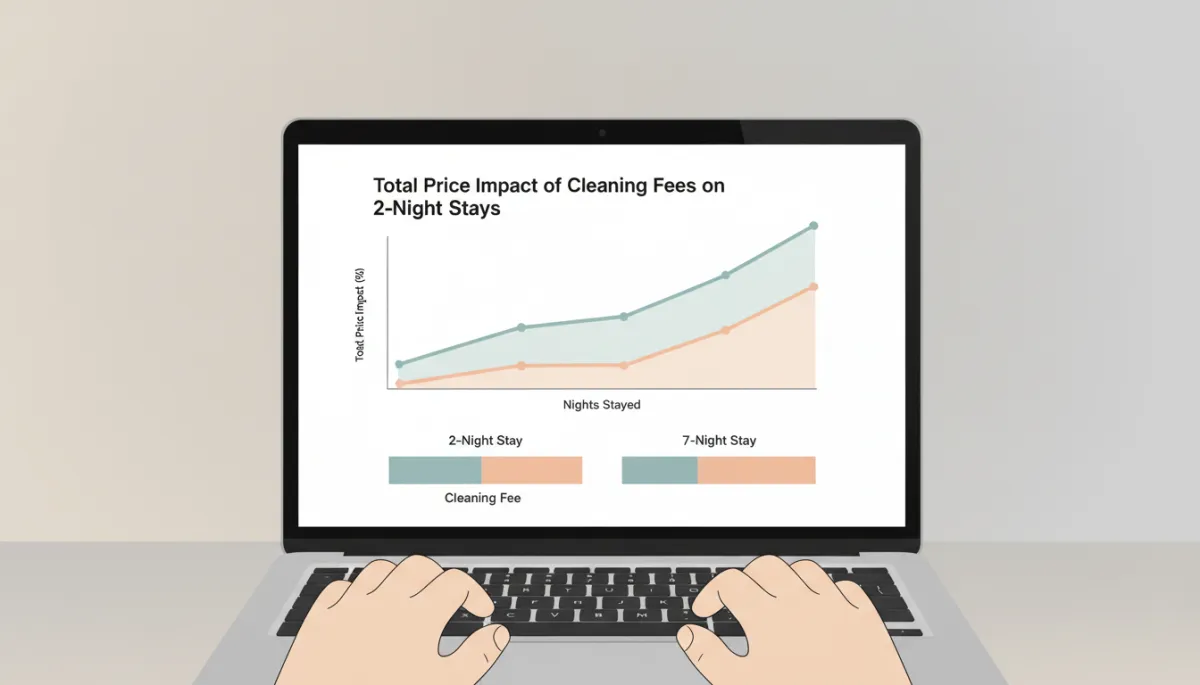
-toned chart-style on a laptop screen comparing total price impact of cleaning fees on 2-night...
Short stays amplify cleaning fees, so the same cost can feel wildly different.
Use Your Own Data: Average Stay Length as a Signal
Don’t guess. Pull your booking history, compute average stay length, and see how exposed you are. Even a simple CSV export and a tiny script helps:
import csv
from statistics import mean

def average_stay_length(csv_path: str) -> float:
    """
    Expect a CSV with a 'nights' column.
    Replace this with your actual export format.
    """
    nights_list = []

    with open(csv_path, newline="") as f:
        reader = csv.DictReader(f)
        for row in reader:
            try:
                nights = int(row["nights"])
            except (ValueError, KeyError):
                continue
            nights_list.append(nights)

    return mean(nights_list) if nights_list else 0.0


avg_nights = average_stay_length("bookings.csv")
print(f"Average stay length: {avg_nights:.1f} nights")
If your average is under 3 nights, you should be extra conservative with your cleaning fee and more aggressive with nightly-rate tuning and minimum-stay rules.
4. Pricing Strategies for Cleaning Fees (Modeled Like a System Design)
Step 1: Benchmark Against Reality, Not Vibes
Start with your actual cleaning cost per turnover:
Cleaner invoice (labor)
Laundry (in-house time or external service)
Supplies and consumables (soap, paper products, etc.)
Coordination/overhead (your time has value, even if you don’t bill it)
Rakidzich’s 2026 benchmarks put median cleaning fees around $89 for 1‑bedrooms and $145 for 3‑bedrooms. Use those as a sanity check. If your one-bedroom fee is $175 in a non-luxury market, you’re probably out of band unless you’re delivering hotel-level service.
Step 2: Keep the Fee Within Healthy Ratios
Several 2026 analyses converge on a similar rule of thumb: keep your cleaning fee under ~18% of the total price on a 3-night stay and within roughly 25–50% of your ADR for optimal performance. You can codify that:
def suggested_cleaning_fee(nightly_rate: float, target_ratio: float = 0.35) -> float:
    """
    Suggest a cleaning fee as a ratio of ADR (25-50% is typical).
    target_ratio = 0.35 means 35% of nightly rate.
    """
    return round(nightly_rate * target_ratio, 2)


adr = 200.0
for ratio in (0.25, 0.35, 0.5):
    print(f"ADR ${adr}, ratio {ratio:.0%} -> fee ${suggested_cleaning_fee(adr, ratio)}")
Use this as a starting point, then adjust based on your actual cost and your market’s median fees.
Step 3: Avoid the “Low Nightly, High Cleaning” Anti-Pattern
Many hosts tried to game guest psychology with a low nightly rate and a high cleaning fee, assuming users only glance at the per-night number. That used to work. It doesn’t anymore. Guests have learned to:
Click through and check the total
Compare cleaning fees across similar listings
Bail out the moment a fee feels like a hidden tax
Airbnb’s total-price-first display and search ranking behavior now punish that pattern. A balanced structure — reasonable nightly rate plus reasonable cleaning fee — almost always outperforms the split strategy in 2026 data.
5. Actual Ways to Reduce Cleaning Costs (Instead of Just Charging More)
If your cleaner quotes feel unsustainably high, the fix isn’t always “raise the fee.” Think like you’re optimizing a slow endpoint: reduce work, reduce variance, and reduce surprises. Practical levers:
Standardize linens and towels. Same color, same counts, duplicate sets. Your cleaner spends less time matching, folding, and hunting for missing pieces.
Upgrade to easy-care textiles. Higher-quality sheets that don’t need ironing, fast-drying towels, mattress protectors that wash quickly — all reduce cycle time.
Eliminate fragile decor. Anything that breaks, chips, or stains easily adds hidden maintenance time. Simplify surfaces and decor to cut micro-tasks.
Batch laundry where possible. If you run multiple units, centralizing laundry or using a service can reduce per-turnover cost.
A $40 reduction in turnover time is almost always worth more than a $40 increase in the fee. Remember, you’re paying Airbnb 15.5% on that extra $40 anyway. Lower cost at the source beats pushing the cost onto the guest and losing bookings.
6. The Hybrid Pricing Approach That Works in 2026
The pattern most successful hosts are converging on looks like this:
A nightly rate that’s slightly higher than the rock-bottom you could charge
A cleaning fee that’s noticeably lower than your true cost
The gap quietly absorbed into the nightly rate, where it’s psychologically easier for guests to accept
Think of it like spreading a fixed overhead across many requests rather than billing one unlucky request for the whole server bill.
A Simple Hybrid Calculator
Here’s a quick way to experiment with a hybrid structure. You decide how much of the real cleaning cost you want to expose as a fee and how much to bake into the nightly rate based on your typical stay length:
def hybrid_pricing(
    base_nightly_rate: float,
    real_cleaning_cost: float,
    avg_nights: float,
    exposed_fraction: float = 0.6,
) -> dict:
    """
    Split cleaning cost between a visible fee and the nightly rate.
    exposed_fraction: percentage of cleaning cost you show as 'cleaning fee'.
    The rest is spread across avg_nights in the nightly rate.
    """
    exposed_fee = real_cleaning_cost * exposed_fraction
    hidden_per_night = real_cleaning_cost * (1 - exposed_fraction) / avg_nights
    new_nightly = base_nightly_rate + hidden_per_night

    return {
        "nightly_rate": round(new_nightly, 2),
        "cleaning_fee": round(exposed_fee, 2),
    }


config = hybrid_pricing(
    base_nightly_rate=180.0,
    real_cleaning_cost=200.0,
    avg_nights=3.0,
    exposed_fraction=0.5,
)

print(config)
Play with the exposed_fraction until your cleaning fee looks competitive in your market, while your total price and margins still work out.
7. How Airbnb’s Search Ranking Treats Your Cleaning Fee
Airbnb’s algorithm is a black box, but we know a few things from public statements and 2026 data:
Airbnb increasingly optimizes for total trip price, not just nightly rate.
Listings with very high cleaning fees relative to ADR or to similar listings in the area see lower visibility and lower conversion.
A listing with a higher nightly rate and low/no cleaning fee can outrank a cheaper nightly rate with a big fee, even when the total is identical.
On top of that, because Airbnb now charges 15.5% on the cleaning fee as well, they’ve quietly aligned incentives: they don’t want hosts shoving margin into cleaning fees that guests hate. They want clean, transparent, total pricing that converts.
📌 Key Takeaway: If your impressions are stable but your views and bookings are sliding, your cleaning fee and total price structure are prime suspects — not just your photos or title.
8. Testing Cleaning-Fee Changes Like a Developer (Not Like a Panicked Host)
Most hosts change their cleaning fee, watch a few days of traffic, panic, and roll it back. That’s like deploying a feature to 5% of users for 48 hours and declaring it a failure. You need a proper experiment:
Define the change. For example: lower the cleaning fee by $25, raise the nightly rate by $10.
Pick a test window. At least 30 days, ideally same season as your baseline data.
Decide what you’re measuring. Views-to-bookings conversion, total revenue, average stay length, or all three.
Don’t touch anything else. No big photo overhaul or title rewrite at the same time, or you’ll never know what actually moved the needle.
A Tiny Experiment Tracker Script
Even a simple script can help you reason about results. Suppose you log monthly stats before and after your change:
from dataclasses import dataclass

@dataclass
class MonthStats:
    views: int
    bookings: int
    revenue: float


def conversion_rate(stats: MonthStats) -> float:
    if stats.views == 0:
        return 0.0
    return round(stats.bookings / stats.views * 100, 2)


before = MonthStats(views=1200, bookings=24, revenue=7200.0)
after = MonthStats(views=1300, bookings=32, revenue=8800.0)

print(f"Before - conv: {conversion_rate(before)}%, revenue: ${before.revenue}")
print(f"After  - conv: {conversion_rate(after)}%, revenue: ${after.revenue}")
You don’t need a full-blown experiment framework, but you do need to give each change enough time and isolate it enough to be meaningful.
Bringing It All Together: Treat Cleaning Fees as Strategy, Not Admin
Cleaning fees feel administrative — a pass-through of what your cleaner charges. But in practice, they’re a core part of your pricing strategy and your UX. In 2026:
Guests are more sensitive to cleaning fees than almost any other line item.
Platforms surface total price and penalize outlier fees in search visibility and conversion.
Your own economics are squeezed by rising cleaning costs and a 15.5% platform fee on the entire subtotal, including cleaning.
The hosts who win aren’t the ones with the cheapest fees; they’re the ones who:
Benchmark against real costs and market medians instead of guessing
Keep cleaning-fee ratios sensible, especially for short stays
Use a hybrid approach that makes the fee feel fair while protecting margin
Continuously test and iterate instead of making one big change and hoping
If you think like a senior engineer about this one line item — measure, refactor, test, deploy, observe — you’ll avoid the mysterious quiet weeks everyone else complains about. Your calendar will stay healthier, your guests will feel the pricing is fair, and your cleaning fee will finally do what it’s supposed to do: support your operation, not sabotage it.